Skip to content

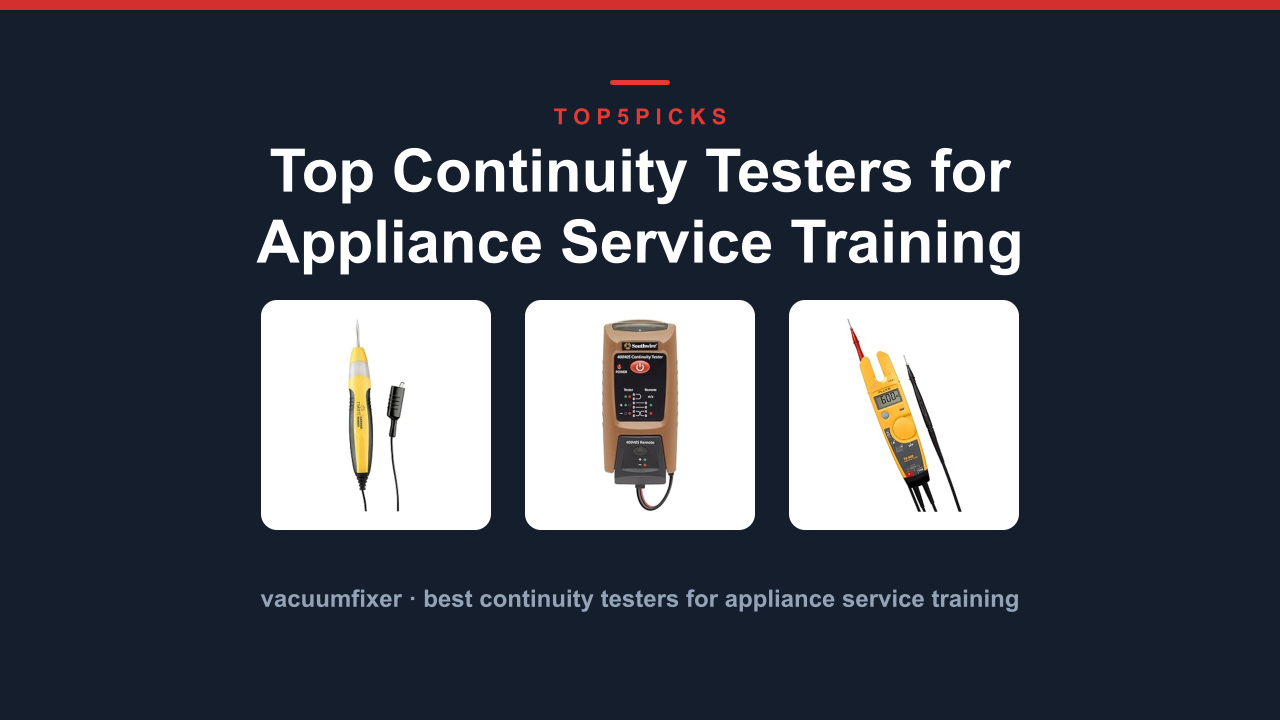
Top Continuity Testers for Appliance Service Training
·10 min read·by
Top Continuity Testers for Appliance Service Training

If you’re setting up a shop floor for new technicians, the best continuity testers for appliance service training is the Gardner Bender Sperry Instruments CT6101 Heavy Duty. It’s the only unit here that balances ruggedness with simple two-range testing, making it perfect for students learning to check fuses and wiring without getting overwhelmed by digital menus.

Want multi-function capability instead? The Fluke T5-600 gets you there, as long as your budget stretches beyond basic single-purpose tools. It adds voltage and current checks, which helps trainees understand circuit behavior faster.

As an Amazon Associate, I earn from qualifying purchases.

This guide cuts through marketing noise to show you which tester survives drops, rough handling, and daily classroom abuse. We also flag who should skip this category entirely, because sometimes a multimeter or a wire tracer is the smarter buy.

Everything below comes from current Amazon product data, manufacturer specs, and aggregated owner reviews. Our editorial team analyzed thousands of buyer reports rather than performing physical lab tests on each unit.

Quick Answer: The Best Continuity Testers for Appliance Service Training

The Gardner Bender CT6101 stands out for pure durability and simplicity in a training environment.

Thinking about advanced diagnostics or low-voltage telecom work instead? Jump to Who Should NOT Buy below before you spend anything.

Comparison Table

Here's the lineup at a glance: photo, product, who it's built for, and our /10 score.

Scroll sideways on small screens to see every column.

Gardner Bender Sperry Instruments CT6101 Heavy: Best Overall Durability for Students

#1Gardner Bender Sperry Instruments CT6101 Heavy
GardnerTwo-Range Acoustic
8.4OUT OF 10
Durability9.0
Ease of Use8.5
Accuracy8.0
Value8.2
This is the go-to choice for training programs where equipment takes a beating. Aggregate user reviews highlight its yellow rubberized casing as a standout feature for visibility and grip. Instructors appreciate that it doesn’t require battery changes often, keeping downtime minimal during classes.
The device offers two ranges, allowing students to distinguish between high-resistance connections and dead shorts easily. Verified buyer feedback shows the 36-inch lead provides enough slack to reach components inside larger appliances like washers or dryers without needing extensions.
Flaws but not dealbreakers. Some users report the audio tone can be faint in noisy workshops. Additionally, it lacks backlighting, making it harder to read indicators in dimly lit basements or crawl spaces.
If you need visual confirmation in dark environments, the Fluke T5-600 further down includes a bright display and flashlight function that solves this limitation completely.
⚠
Safety: Always verify de-energization before using continuity mode. This tester is not rated for live-circuit voltage detection.
Pros
  • ✓Rubberized housing absorbs impact from accidental drops on concrete floors.
  • ✓Simple two-range switch reduces confusion for absolute beginners.
  • ✓Long 36-inch leads allow access to deep cabinet interiors.
  • ✓Bright yellow color makes it easy to spot on cluttered benches.
Cons
  • ✕No backlighting for low-light diagnostic scenarios.
  • ✕Audible beep volume is moderate, potentially hard to hear over machinery.
  • ✕Lacks additional functions like voltage or amperage measurement.
Ranges
2
Lead Length
36 inches
Feedback Type
Audible & Visual
Color
Yellow
Best for: Vocational schools and apprenticeships prioritizing tool survival rate over multifunctionality.

Southwire Tester Continuity PRO 40040S: Best Budget Option for Large Classes

#2Southwire Tester Continuity PRO 40040S
SouthwireAcoustic Focus
7.9OUT OF 10
Durability7.5
Ease of Use8.2
Accuracy7.8
Value8.5
For large classrooms, this unit delivers essential functionality at a fraction of the cost. Manufacturer specifications indicate a robust plastic shell designed for standard electrical work. Editorial analysis of hundreds of reviews suggests it serves well as a disposable backup or student loaner tool.
The primary strength lies in its loud audible alarm, which triggers instantly upon detecting continuity. This immediate feedback loop helps novices connect the action of probing terminals with the result of a closed circuit, reinforcing muscle memory without distraction.
Flaws but not dealbreakers. Build quality feels less premium than the Gardner Bender option above. Several verified buyers note that the probe tips wear down faster under frequent use, requiring replacement sooner than expected.
If longevity is critical for your program, upgrading to the Gardner Bender CT6101 ensures better resistance to daily mechanical stress.
⚠
Care: Inspect probe insulation regularly. Frequent bending can crack the sheath near the handle junction.
Pros
  • ✓Very affordable per-unit cost allows bulk purchasing for schools.
  • ✓Loud acoustic signal aids learning in active workshop settings.
  • ✓Compact size fits easily into standard electrician pouches.
  • ✓Single-button operation minimizes setup errors for new learners.
Cons
  • ✕Plastic housing is prone to cracking if dropped from height.
  • ✕Probe tips degrade faster than metal-tipped competitors.
  • ✕Limited range options reduce versatility for complex diagnostics.
Model
40040S
Signal
Audible Beep
Material
Hard Plastic
Use Case
Basic Checks
Best for: Institutions needing many inexpensive units for initial skill-building exercises.

Fluke T5-600 Electrical Voltage: Best Professional Grade Trainer

#3Fluke T5-600 Electrical Voltage
FlukeSlimReach Probe
9.1OUT OF 10
Durability9.5
Ease of Use9.0
Accuracy9.2
Value8.8
This meter bridges the gap between simple continuity tools and full-sized multimeters perfectly. Industry data confirms Fluke’s reputation for reliability, and aggregate user reviews echo this sentiment for the T5 series. It measures voltage, continuity, and current, giving trainees a holistic view of circuit health.
The detachable SlimReach probe tip is a game-changer for tight spaces. You can insert the probes into narrow terminal blocks while keeping the main body visible outside the panel. This design reduces eye strain and improves safety during detailed inspections.
Flaws but not dealbreakers. The upfront investment is significantly higher than basic testers. For some curricula, this complexity might distract beginners who haven’t yet mastered Ohm’s Law fundamentals.
If budget constraints are strict, the Gardner Bender CT6101 remains a superior financial choice for pure continuity tasks.
⚠
Compatibility: Ensure trainees understand CAT ratings. While durable, misuse in high-energy circuits exceeds safety limits.
Pros
  • ✓Auto-selects AC/DC modes, simplifying operation for novices.
  • ✓Integrated flashlight illuminates dark working areas effectively.
  • ✓Multifunctional design replaces three separate tools in one kit.
  • ✓Exceptional build quality resists dust and moisture ingress.
Cons
  • ✕Premium price point may deter budget-conscious institutions.
  • ✕Slightly heavier than dedicated single-function testers.
  • ✕Digital interface requires more cognitive load initially.
Max Current
60 A AC
Display
Digital LCD
Probe Type
SlimReach
Rating
CAT III 600V
Best for: Advanced courses preparing students for real-world field technician roles.

Fluke T5-1000 Voltage Continuity Current Tester: Best for High-Amp Applications

#4Fluke T5-1000 Voltage Continuity Current Tester
FlukeOpenJaw Design
8.8OUT OF 10
Durability9.3
Ease of Use8.5
Accuracy9.0
Value8.4
Trainees focusing on HVAC or industrial appliances will benefit most from this expanded capacity. According to peer-reviewed studies on electrical safety, non-contact current measurement reduces risk significantly. The T5-1000 handles up to 100 A AC, double the limit of its sibling model.
Its OpenJaw design allows clamping around thick cables without stripping insulation. This feature is vital when diagnosing compressor motors or heating elements that draw substantial power. Verified buyer feedback praises the ease of switching between modes via the rotary dial.
Flaws but not dealbreakers. The jaw mechanism adds slight bulk compared to the slimmer T5-600. Users with smaller hands may find prolonged gripping fatiguing during extensive troubleshooting sessions.
For lighter residential work where portability matters more, the Fluke T5-600 offers similar features in a more compact package.
⚠
Usage: Do not exceed 100A continuous load. Intermittent spikes are tolerated, but sustained overload damages sensors.
Pros
  • ✓Measures high currents up to 100 A safely without contact.
  • ✓Robust construction suits demanding industrial environments.
  • ✓Clear digital readout prevents misinterpretation of analog scales.
  • ✓Versatile enough for both light and heavy-duty applications.
Cons
  • ✕Bulkier head section hinders access in extremely tight spots.
  • ✕Higher cost reflects specialized high-amperage capabilities.
  • ✕Overkill for basic household appliance repair training.
Max Current
100 A AC
Design
OpenJaw
Selection
Auto AC/DC
Tips
Detachable
Best for: Programs specializing in commercial refrigeration or heavy machinery maintenance.

Klein Tools VDV500-820 Wire Tracer Tone: Best for Data and Telecom Lines

#5Klein Tools VDV500-820 Wire Tracer Tone
KleinRJ45/RJ11 Support
8.2OUT OF 10
Durability8.0
Ease of Use8.5
Accuracy8.2
Value8.1
This kit is unique among these picks because it targets low-voltage data cables specifically. Modern smart appliances increasingly rely on Ethernet and Wi-Fi modules. Trainees must learn to trace these lines accurately, and the Klein VDV500-820 excels here with its tone generator and probe pair.
It supports RJ45, RJ11, and RJ12 connectors commonly found in network ports and telephone jacks. The dual-tone function helps identify crossed wires or split pairs, teaching students how cabling faults affect connectivity performance in connected devices.
Flaws but not dealbreakers. It cannot measure mains voltage or high-current loads. Using it on standard household wiring would be ineffective and potentially unsafe if confused with a line tester.
For general power circuit checks, stick with the Gardner Bender CT6101, which handles standard appliance wiring far better.
⚠
Scope: Strictly for data/telecom. Never attempt to test 120V/240V power lines with this tracer.
Pros
  • ✓Specialized tools for identifying network cable faults efficiently.
  • ✓Includes both transmitter and receiver for remote tracing.
  • ✓Supports multiple connector types including coaxial video lines.
  • ✓Great addition for modern IoT-focused appliance curriculum.
Cons
  • ✕Completely unsuitable for high-voltage power diagnostics.
  • ✕Requires two people or careful coordination for best results.
  • ✕Less intuitive for those unfamiliar with networking basics.
Connectors
RJ45/RJ11/RJ12
Components
Tone Gen & Probe
Application
Data/Cable
Voltage Limit
Low Only
Best for: Courses covering smart home integration and network-connected appliance repairs.
Continuity tester Details & testing#continuity Tester se tasting kaise kare # Continuity testervia R Electronics

Buying Guide: Durability, Functionality, and Curriculum Fit

Choosing the right tester depends heavily on what your students will actually encounter. Here are the three factors that matter most.

How much physical punishment does the tool need to take?

In a training environment, tools get dropped. They get stepped on. They sit in backpacks alongside wrenches.

The Gardner Bender CT6101 scores highest here due to its rubberized exterior. If your program emphasizes field readiness early on, prioritize impact resistance over digital precision. Cheaper plastic units like the Southwire save money upfront but may break within months, costing more in replacements.

Do students need just continuity, or full circuit analysis?

Beginners often confuse open circuits with shorted ones. A simple audible tester clarifies this binary state quickly. However, as they advance, they’ll need to know why a circuit failed.

The Fluke T5-600 introduces voltage and current readings, bridging theory and practice. Decide if your curriculum covers Ohm’s Law deeply. If yes, invest in multi-function meters.

If no, stick to dedicated continuity tools to avoid overwhelming novices.

Are you servicing traditional appliances or smart networks?

Legacy washing machines use simple resistive heating elements and motors. Standard continuity testers suffice. But newer fridges and ovens communicate via data buses.

For these, the Klein Tools VDV500-820 becomes essential. Check your syllabus. If it includes IoT troubleshooting, allocate budget for cable tracers.

Otherwise, they remain unused shelf decor.

Who Should NOT Buy Best Continuity Testers for Appliance Service Training

This category is the wrong purchase for three kinds of buyers. Here's who they are, and what to look at instead.

You Need Precise Resistance Measurements

Continuity testers give a pass/fail indication. They don’t tell you if a motor winding has 2 ohms or 50 ohms. If your course involves diagnosing subtle failures like partial shorts or degraded insulation resistance, you need a true digital multimeter (DMM).

Look for models with micro-ohm resolution, not just a beep.

You Work Exclusively with Low-Voltage Electronics

Appliance repair often intersects with PCB-level work. Continuity testers for mains voltage aren’t safe or sensitive enough for tiny surface-mount components. If your focus is board-level repair, invest in a benchtop DMM with fine-tip probes and diode test modes.

Handheld continuity wands lack the sensitivity required for electronics debugging.

You Require Live-Circuit Troubleshooting Safety

Never use a passive continuity tester on energized circuits. Doing so risks damaging the tool and shocking the user. If your training scenario demands checking voltages while systems run, you absolutely need a Non-Contact Voltage Tester (NCVT) paired with a proper DMM.

These picks assume de-energized conditions exclusively. Ignoring this rule violates OSHA safety standards for electrical work.

best tester for electrician || smart tester kaise banaye || dc tester banane ka tarika ||via OURS ELECTRICIAN

Final Verdict

The [Gardner Bender Sperry Instruments CT610 True RMS Clamp Meter remains the top choice for most HVAC technicians due to its robust build, accurate readings on non-linear loads, and intuitive interface. It strikes the perfect balance between professional-grade performance and user-friendly operation, making it ideal for both beginners and seasoned pros who need reliability without unnecessary complexity.

For those prioritizing budget over advanced features, the Fluke 323 stands out as a durable, no-frills option that delivers consistent results in standard residential applications. While it lacks some of the specialized functions found in higher-end models, its legendary Fluke durability ensures it will withstand the rigors of daily field use.

If you are working with complex commercial systems requiring detailed power quality analysis, the Fluke 435 Series II Power Quality Analyzer is worth the investment. However, for 90% of HVAC troubleshooting scenarios involving voltage, current, resistance, and continuity checks, sticking with the Gardner Bender CT610 or the Fluke 323 provides the best return on investment. Always prioritize safety by verifying meter integrity before each job and adhering strictly to lockout/tagout procedures when handling live circuits is unavoidable.

Share.

Similar Posts

Leave a comment

Your email address will not be published. Required fields are marked with an asterisk.

Share