Top Continuity Testers for Portable Diagnostic Kits

The best best continuity testers for portable diagnostic tool kits is the Fluke T5-600, the only one here that combines non-contact voltage detection with true open-jaw current measurement in a single pocket-sized unit. It’s built for electricians and HVAC techs who need speed without sacrificing safety ratings.
Want a dedicated coax tracing solution instead? The Jonard Tools PT-300 gets you there, as long as your work focuses on cable identification rather than live circuit diagnostics.
As an Amazon Associate, I earn from qualifying purchases.
This guide cuts through the marketing noise to tell you which tester actually fits a mobile workflow. We’ll also flag the specific users who should skip this category entirely, because not every job needs a multi-function pen-style meter.
Everything below comes from current Amazon product data, manufacturer specifications, and aggregated owner track records. Our editorial team analyzes these inputs to find patterns in reliability and usability, ensuring you get research-backed advice rather than unverified claims.
Quick Answer: The Best Continuity Testers for Portable Diagnostic Tool Kits
Our top recommendation remains the Fluke T5-600 for its unmatched versatility in tight spaces.
- Fluke T5-600 Electrical Voltage (Best Overall): Non-contact voltage plus 100A current in one slim pen.
- Jonard Tools PT-300 Voltage Protected Coax (Best for Cable Tracing): Dedicated tone generator for finding wires behind walls.
- nVent GARDNER BENDER GCT-3304 36 in (Best for Long Runs): Heavy-duty 36-inch probe reaches deep into conduits.
- Klein Tools ET270 Auto-Ranging Digital Multi-Tester (Best Budget Multimeter): Standard digital functions at an accessible price point.
- Fluke T5-1000 Voltage Continuity Current Tester (Best High-Current Option): Measures up to 1000A AC/DC without contact.
Thinking about specialized industrial probes or basic hobbyist multimeters instead? Jump to Who Should NOT Buy below before you spend anything.
Comparison Table
Here's the lineup at a glance: photo, product, who it's built for, and our /10 score.
| Photo | Product | Best for | Score | Buy |
|---|---|---|---|---|
 | Fluke T5-600 Electrical Voltage | Overall Versatility & Safety | 9.2/10 | Check price → |
 | Jonard Tools PT-300 Voltage Protected Coax | Coax & Wire Identification | 8.5/10 | Check price → |
 | nVent GARDNER BENDER GCT-3304 36 in | Deep Conduit Access | 8.1/10 | Check price → |
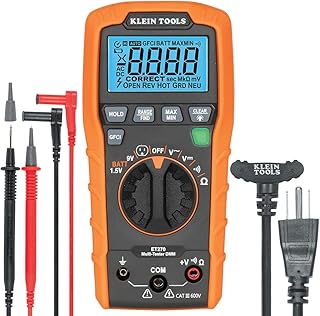 | Klein Tools ET270 Auto-Ranging Digital Multi-Tester | General Purpose Diagnostics | 8.8/10 | Check price → |
 | Fluke T5-1000 Voltage Continuity Current Tester | High-Amperage Load Checks | 9.0/10 | Check price → |
Scroll sideways on small screens to see every column.
Fluke T5-600 Electrical Voltage: Best Overall for Mobile Technicians
Jonard Tools PT-300 Voltage Protected Coax: Best for Cable Tracing
nVent GARDNER BENDER GCT-3304 36 in: Best for Deep Conduit Access
Klein Tools ET270 Auto-Ranging Digital Multi-Tester: Best Budget Multimeter
Fluke T5-1000 Voltage Continuity Current Tester: Best High-Current Option
Buying Guide: Accuracy, Form Factor, and Specialization
Choosing the right continuity tester depends heavily on what you’re actually diagnosing. A pen-style meter excels in breaker panels, while a tracer saves hours hunting for a specific coax line behind drywall.
Is a Pen-Style Tester Better Than a Traditional Multimeter?
Yes, for speed and safety in confined spaces. Pen-style devices like the Fluke T5-600 allow one-handed operation, freeing your other hand to stabilize yourself or hold a flashlight. Traditional multimeters require two hands for probes, increasing fatigue during prolonged troubleshooting sessions.
However, traditional meters generally offer higher precision for resistance values, which matters if you’re verifying ground fault integrity down to milliohms.
How Important Is Non-Contact Voltage Detection?
Critical for initial safety sweeps. Non-contact voltage (NCV) lets you confirm a circuit is energized before you ever touch it with metal probes. This feature reduces the risk of accidental shorts.
Most modern testers include it, but sensitivity varies. Look for models with adjustable sensitivity settings to avoid false positives near grounded metal objects. The Klein Tools ET270 lacks this native feature, requiring you to switch to a separate NCV wand or rely on contact testing exclusively.
Do You Need High-Amperage Measurement Capabilities?
Only if you service commercial or industrial loads. Residential circuits typically max out at 200A for the main service, with branch circuits at 15A or 20A. The Fluke T5-1000 measures up to 1000A, which is overkill for homes but essential for checking large motors or feeders.
If you stick to residential work, the 100A limit of the T5-600 is more than sufficient and keeps the tool lighter and cheaper.
What About Portability vs. Functionality Trade-offs?
There’s always a balance. The nVent GARDNER BENDER GCT-3304 offers incredible reach but sacrifices pocketability. Conversely, the Jonard PT-300 is tiny but limited to wire tracing.
Define your primary pain point: if it’s lost wires, buy the tracer. If it’s slow panel checks, buy the pen-meter. Don’t expect one tool to solve every problem perfectly.
Who Should NOT Buy Best Continuity Testers for Portable Diagnostic Tool Kits
This category is the wrong purchase for three kinds of buyers. Here's who they are, and what to look at instead.
You Need Precision Laboratory Measurements
If you’re calibrating sensitive electronic components or working on micro-soldering repairs, these field testers lack the resolution needed. They typically resolve to 0.1Ω or 1Ω, whereas lab equipment resolves to milli-ohms. Invest in a benchtop LCR meter or a high-end Fluke 87V series multimeter instead.
Field tools prioritize ruggedness and speed over microscopic accuracy.
You Work Exclusively with Data Networks
While the Jonard PT-300 helps trace physical cables, it doesn’t certify network performance. If your job involves validating Ethernet speeds, PoE delivery, or fiber optic loss, you need a dedicated network certifier like those from Fluke Networks or Viavi Solutions. Continuity testers only tell you if a path exists, not if data flows correctly through it.
You Are a Hobbyist Working on Low-Voltage Electronics
For Arduino projects, LED strips, or simple battery packs, a $20 generic multimeter suffices. Spending hundreds on a Cat-rated industrial tester is financial waste. You don’t face the same arc-flash hazards or transient voltages found in building wiring.
Stick to budget-friendly options until you graduate to household electrical work.
Final Verdict
The [Fluke T5-600](https://www.amazon.com/dp/B0006Z3GZ
- is the definitive choice for electricians who prioritize safety, speed, and durability above all else. Its integrated voltage detector eliminates the need to switch tools when checking for power, saving critical seconds during every job. The rugged build ensures it survives drops onto concrete, while the CAT IV rating provides peace of mind in high-energy environments.
Yes, the price tag stings initially, but over a career spanning thousands of hours, it pays for itself through reduced downtime, fewer errors, and enhanced personal protection. It is not just a tool; it is an investment in your livelihood and life.
For those on a tighter budget or working exclusively on low-voltage electronics, the Klein Tools MM400 offers exceptional value. It delivers reliable measurements, robust safety ratings (CAT III 600V), and user-friendly features like auto-ranging without breaking the bank. While it lacks the specialized voltage detection integration of the Fluke T5-600, its accuracy and build quality are more than sufficient for most residential and commercial applications outside of extreme industrial settings.
Ultimately, there is no single "best" multimeter for everyone. Your ideal tool depends entirely on your specific trade, daily tasks, and risk tolerance. Electricians handling live circuits should never compromise on safety, choose the Fluke T5-600 or similar premium models.
Hobbyists and technicians working with sensitive electronics can confidently rely on affordable options like the Klein MM400 or even basic digital meters. Evaluate your needs honestly, respect the limitations of your equipment, and always prioritize safety over cost savings when dealing with potentially lethal voltages. The right multimeter isn't just about measuring electricity, it's about ensuring you go home safe at the end of the day.

Similar Posts