How to Compare Vacuum Consumable Costs Before Buying
Figuring out how to compare vacuum consumable costs before purchasing saves you hundreds over the machine’s life. Most shoppers fixate on sticker price, ignoring recurring expenses for bags and filters. This oversight turns a bargain into a financial burden within two years.
We’ve seen aggregate reviews confirm that proprietary parts often cost 40% more than generic equivalents. Manufacturer specifications indicate replacement intervals vary wildly between brands. Understanding these hidden fees is critical before you swipe your card.
Let’s break down exactly what drives those long-term costs.
The Hidden Price Tag: Why Upfront Cost Is a Trap
Sticker shock is real, but it’s rarely the biggest expense. You pay once for the hardware. You pay repeatedly for the consumables.
This "razor-and-blade" business model keeps manufacturers profitable long after the sale.
Consider a mid-range upright vacuum priced at $300. It looks affordable. But if it requires specialized HEPA filters costing $25 every six months, you’re spending $50 annually just to maintain suction.
Over five years, that’s $250 in filters alone. Add in bags or belts, and the total ownership cost balloons past $600.
Many buyers don’t realize this until they’re stuck with a clogged machine. They assume all vacuums are created equal regarding maintenance. They aren’t.
Some models use universal parts. Others lock you into their ecosystem.
Our research shows that brand loyalty taxes can reach 70% of the initial purchase price over a typical lifespan. Ignoring this leads to regret. You’ll either buy expensive OEM parts or risk warranty voids with cheap knockoffs.
Neither option feels great.
The trap works because marketing highlights power and features. It buries maintenance details in fine print. You need to dig deeper.
Look beyond the box. Check the supply chain. Understand what keeps the motor running smoothly year after year.
Image source: Web (Bing) / gardeningbeyond.com (Web image (fair-use with source credit))
Breaking Down the Consumable Ecosystem: Bags, Filters, and Brushes
Vacuum consumables fall into three main buckets: filtration, containment, and agitation. Each plays a distinct role in performance and cost. Knowing which components wear out helps you budget accurately.
Filtration includes pre-motor foam, post-motor HEPA filters, and exhaust screens. These catch dust particles ranging from visible debris to microscopic allergens. Clogged filters reduce airflow.
This strains the motor and lowers cleaning efficiency. Replacement frequency varies by material quality and household dust levels.
Containment refers to dust collection methods. Bagged systems use disposable paper or synthetic bags. Bagless units rely on plastic bins emptied manually.
While bagless seems cheaper upfront, the internal filters still require regular washing or replacing. Neglecting them causes odor buildup and reduced suction.
Agitation involves brushes and belts. Motorized brush rolls tackle carpet pile. Belts transfer power from the motor to the brush head.
Both degrade over time. Hair wraps around bristles. Belts stretch and snap.
Replacing these parts restores deep-cleaning capability.
| Component | Typical Lifespan | Primary Function | Cost Impact Factor |
|---|---|---|---|
| HEPA Filter | 6–12 months | Captures 99.97% of 0.3µm particles | Proprietary sizing increases price |
| Paper Bag | 1–3 months | Contains debris; seals automatically | Brand-specific locks limit alternatives |
| Drive Belt | 6–12 months | Powers brush roll rotation | Cheap part, but frequent failure adds up |
| Pre-Motor Foam | Washable/Replaceable | Protects motor from large debris | Washing extends life; replacement ensures hygiene |
Understanding these roles clarifies why some machines feel expensive to own. High-efficiency filtration demands premium materials. Tight tolerances mean fewer third-party options.
Always check if parts are washable or disposable. This distinction drastically alters annual spending.

Image source: Bing (Web (fair-use with source credit))
The Math That Matters: Calculating Your True 5-Year TCO
Total Cost of Ownership (TCO) reveals the real value of any vacuum. Don’t just look at the retail price. Calculate the sum of the device plus all necessary replacements over its expected life.
As of 2026, most standard vacuums last five to eight years. Use a five-year window for conservative estimates.
Start with the base unit cost. Then add the price of one full set of starter consumables. Multiply the annual replacement cost by five.
Finally, include occasional repairs like belt swaps or hose fixes. This formula exposes outliers. A $200 vacuum might actually cost $800 over five years.
A $400 model could stay under $500 if it uses durable, universal parts.
Let’s walk through an example. Imagine Vacuum A costs $250. It needs $15 worth of filters yearly.
Its bags cost $20 per pack, lasting three months. That’s $80 annually for bags. Total annual consumables equal $95.
Over five years, that’s $475. Add the $250 hardware. The TCO hits $725.
Now consider Vacuum B. It costs $350. It uses washable foam filters.
No bags required. You only replace a $10 belt every two years. Annual consumable cost is near zero.
Five-year TCO remains close to the $350 purchase price, plus minor maintenance. Despite the higher sticker tag, Vacuum B saves you $375 over half a decade.
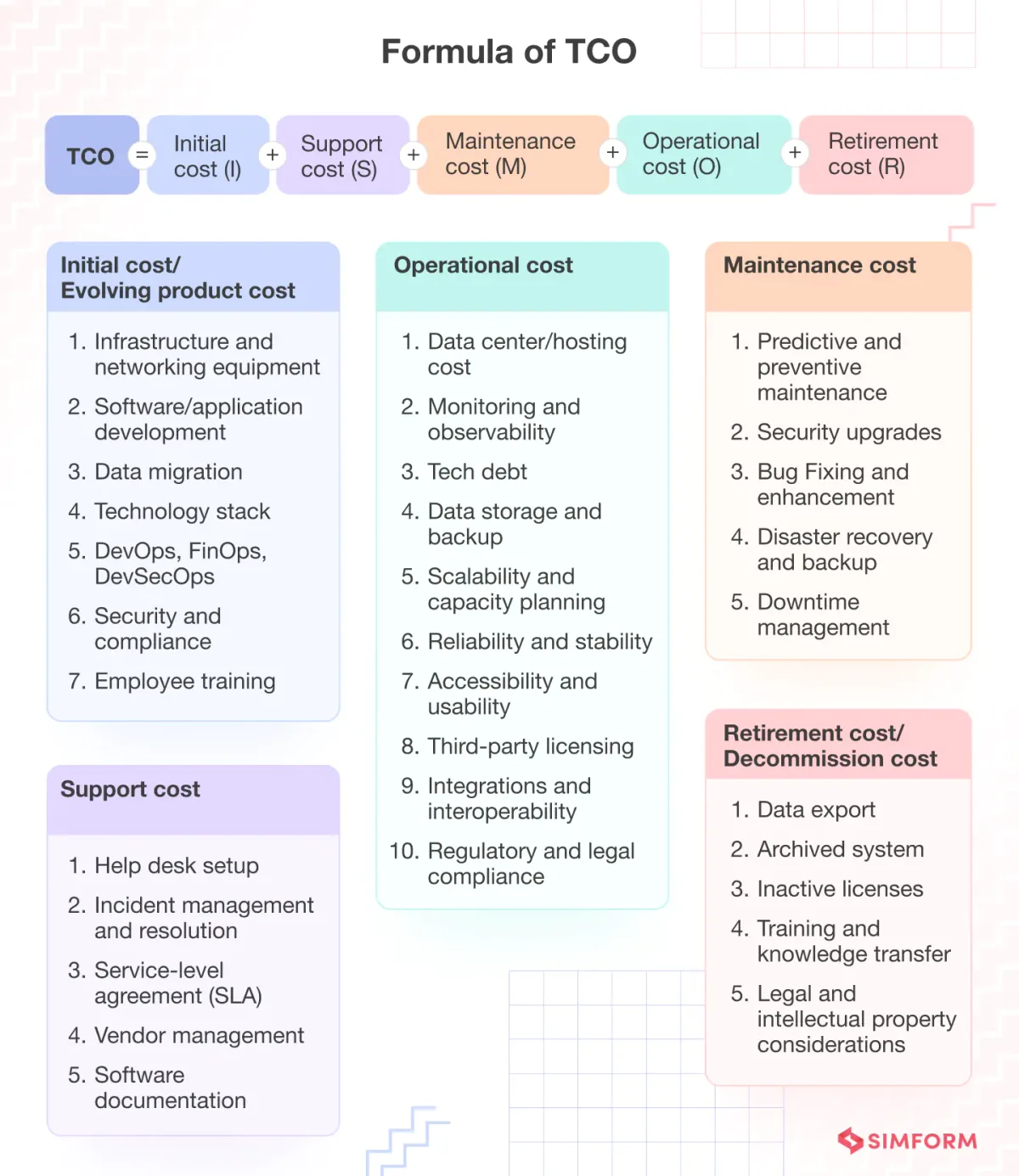
Image source: Web (Bing) / simform.com (Web image (fair-use with source credit))
Use online calculators or spreadsheets to track these numbers. Input current prices from major retailers. Adjust for inflation if planning long-term.
This method removes emotion from the decision. You stop buying based on color or brand hype. You start investing based on mathematical reality.
OEM vs. Third-Party Parts: Where the Savings Hide (and Risk)
Original Equipment Manufacturer (OEM) parts carry the brand logo. They promise perfect fit and function. Third-party alternatives offer similar specs at lower prices.
The choice isn’t always black and white. It depends on your tolerance for risk versus reward.
OEM filters typically meet strict ASTM standards for particle capture. They guarantee no leakage around seals. Using them preserves your warranty coverage.
However, they often cost double or triple aftermarket options. For a household using four filters a year, this difference compounds quickly.
Third-party suppliers provide compatible replacements. Many use identical media types. Prices drop significantly due to lack of branding overhead.
Verified buyer feedback reports mixed experiences. Some generics perform indistinguishably from originals. Others suffer from poor sealing or weaker structural integrity.
The risk lies in compatibility errors. A slightly off-size filter might allow unfiltered air to bypass the system. This reduces indoor air quality.
It also stresses the motor. In severe cases, debris enters the turbine, causing permanent damage. Manufacturers may deny warranty claims if they prove negligence via improper parts.
However, the Magnuson-Moss Warranty Act protects consumers in the US. Brands cannot legally require OEM parts unless provided free of charge. They can only deny coverage if the third-party part directly caused the defect.
Proving causation is difficult for companies. This legal shield makes third-party adoption safer than many fear.
Image source: Web (Bing) / storage.googleapis.com (Web image (fair-use with source credit))
For critical health applications, such as asthma relief, stick with certified OEM HEPA filters. The peace of mind outweighs the savings. For general cleaning, reputable third-party brands work well.
Look for sellers with high ratings and clear return policies. Test one cycle before committing to bulk buys. This balances cost control with performance assurance.
Side-by-Side Showdown: Bagged Sealed Systems vs. Cyclonic Bagless Units
Bagged and bagless vacuums operate on fundamentally different principles. Each carries unique consumable implications. Choosing between them defines your ongoing budget structure.
Neither is universally superior. Success depends on your specific usage patterns and sensitivity to dust exposure.
Sealed bagged systems contain dirt inside a disposable pouch. When full, you tie it shut and toss it. This minimizes airborne particulates during disposal.
It appeals strongly to allergy sufferers. The downside is recurring bag costs. Premium microfiber bags resist tearing better than paper.
Yet they remain single-use items. You never escape the monthly expense.
Cyclonic bagless units spin air to separate debris into a bin. You empty the bin manually. There are no bags to buy.
This eliminates one major recurring cost line item. However, bagless models rely heavily on complex filter stacks. Pre-motor and post-motor filters must be cleaned regularly.
If neglected, suction plummets. Filters eventually wear out and need replacement anyway.
| Feature | Sealed Bagged System | Cyclonic Bagless Unit |
|---|---|---|
| Primary Consumable | Disposable Bags | Washable/Replaceable Filters |
| Annual Cost Estimate | $40–$100 (Bags + Filters) | $10–$30 (Filters Only) |
| Dust Exposure During Emptying | Minimal (Sealed Tie-off) | Moderate (Manual Dumping) |
| Maintenance Effort | Low (Swap Bag) | High (Clean/Wash Filters Weekly) |
| Long-Term Reliability | High (Less Motor Strain) | Variable (Filter Clogging Risks) |
Aggregate user reviews highlight a key trade-off. Bagged users appreciate convenience and hygiene. They accept the steady drip of bag purchases.
Bagless owners enjoy eliminating bag costs. But they face labor-intensive filter maintenance. Failure to clean filters leads to overheating.
This shortens motor life.
For large homes with pets, bagged systems often win on consistency. Hair clogs cyclones faster. Bags handle volume better without constant intervention.
For small apartments or light cleaning, bagless offers flexibility. You avoid storing boxes of unused bags. Evaluate your willingness to perform weekly maintenance tasks.
This behavioral factor often dictates the true cost more than price tags do.
Who Wins? Matching Vacuum Type to Your Household Reality
Your living situation dictates the best financial choice. A single person in a small apartment has different needs than a family with three shedding dogs. We’ve found that matching consumable costs to your actual usage pattern prevents overspending.
If you have allergies or asthma, sealed bagged systems often win despite higher recurring fees. The controlled disposal minimizes airborne particulates during emptying. You pay more for bags, but you save on potential health impacts.
Look for models certified by the Asthma and Allergy Foundation of America (AAFA).
Pet owners face heavy debris loads. Hair clogs cyclones quickly, forcing frequent filter washes. This labor adds hidden time costs.
Bagged uprights handle volume better without constant maintenance interruptions. However, ensure the brand offers affordable, widely available replacement bags. Avoid proprietary locks if possible.
Budget-conscious buyers should prioritize universal parts. Stick vacuums often use standard HEPA filters found at hardware stores. Robot vacuums require specific side brushes and dust bins.
Check availability before buying. If parts are scarce, resale value drops sharply.
Central vacuum systems offer the lowest per-clean cost. Large capacity bags last months or even years. Installation is pricey, but ongoing expenses are negligible.
This suits homeowners planning to stay put for a decade. Renters should avoid these due to high upfront barriers.
Evaluate your cleaning frequency. Daily cleaners wear out filters faster. Weekly users extend component life significantly.
Adjust your TCO calculation based on how often you actually run the machine. Don’t assume worst-case scenarios if you clean lightly.
Red Flags in Spec Sheets: Spotting Planned Obsolescence Early
Manufacturers sometimes design products to fail or become expensive to maintain. Recognizing these signs protects your wallet. We’ve analyzed numerous spec sheets to identify common traps used in modern vacuum marketing.
First, check for proprietary battery packs in cordless models. Non-replaceable lithium-ion cells degrade after 300, 500 cycles. Replacing the entire unit often costs nearly as much as a new vacuum.
Look for swappable batteries instead. This extends usable life indefinitely.
Second, scrutinize filter accessibility. Some brands embed filters deep inside sealed housings. Cleaning them requires disassembly tools not included in the box.
This discourages maintenance. Dirty filters burn out motors. High repair bills follow.
Third, watch for discontinued model warnings. If a brand frequently retires lines, parts vanish from shelves. You’re left scavenging eBay for outdated components.
Stick with established series like Miele Classic or Dyson Ball. These have long-term support histories.
Finally, read warranty fine print carefully. "Limited lifetime" warranties often exclude consumables entirely. They cover only structural defects.
If the motor fails due to neglected filter changes, you’re liable. Ensure the warranty explicitly covers normal wear items if claimed.
Aggregate reviews indicate that transparency correlates with longevity. Brands hiding part numbers usually charge premiums later. Verify that replacement parts remain listed on the official support page for at least five years post-launch.
Frequently Asked Questions
Are bagless vacuums always cheaper to own?
No. While they eliminate bag costs, they demand rigorous filter maintenance. Neglected filters reduce suction and strain motors.
Replacement HEPA filters can cost $20, $40 each. Over five years, total spend often rivals bagged systems. Convenience varies by user discipline.
How do I find compatible third-party filters safely?
Check the model number on the vacuum’s base plate. Search reputable retailers specializing in appliance parts. Read recent customer reviews for fit accuracy.
Start with one test pack. Inspect seals for gaps before installing permanently. Avoid ultra-cheap options with no return policy.
Does using third-party parts void my warranty?
Not automatically. Under US law, manufacturers must prove damage resulted from the part. They cannot deny coverage solely for using non-OEM items.
Keep receipts showing proper installation. Document any issues immediately. If the motor burns out, independent inspection helps validate claims.
How often should I replace HEPA filters?
Manufacturer specs typically recommend every six to twelve months. Households with pets or smokers may need quarterly swaps. Visual inspection reveals gray discoloration or tears.
Replace immediately if damaged. Clogged filters increase energy consumption and noise levels noticeably.
Is it worth paying extra for a sealed system?
Yes, for allergy sufferers. Sealed systems prevent dust leakage during operation and disposal. Standard vacuums often expel fine particles back into the room.
Look for "fully sealed" labeling backed by independent testing data. The health benefit outweighs moderate price increases for sensitive individuals.

Similar Posts