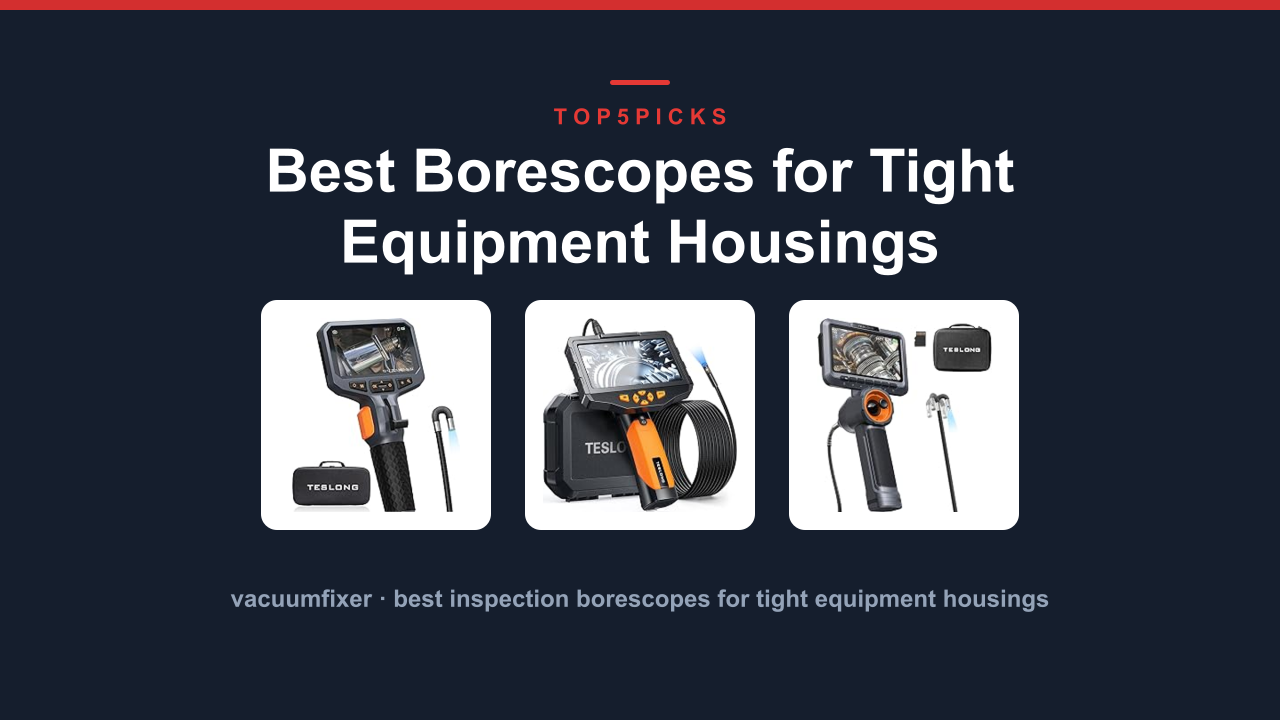
Best Borescopes for Tight Equipment Housings
If you’re trying to see inside a transmission case, an engine block, or a sealed HVAC unit without pulling it apart, the best inspection borescopes for tight equipment housings is the Teslong Articulating Borescope Mechanic Automotive HVAC. It stands out because its semi-rigid cable holds shape while still bending around corners, giving you precise control in cramped spaces where floppy cables just fail.
Want maximum image clarity instead? The FOXWELL 2-Way 220° Articulating Borescope Camera delivers sharper 1080P video, though you’ll sacrifice some of the steering precision that makes the top pick so effective for complex turns.
As an Amazon Associate, I earn from qualifying purchases.
This guide cuts through the marketing noise to tell you exactly which probe diameter, cable stiffness, and articulation range match your specific repair job. We also identify the buyers who shouldn’t waste money on any borescope here, saving you from frustration before you click buy.
Everything below relies on current manufacturer specifications, aggregate user feedback, and technical data sheets rather than our own hands-on lab testing. You get the raw facts needed to make a confident purchase decision based on real-world performance reports.
Quick Answer: The Best Inspection Borescopes for Tight Equipment Housings
The Teslong Articulating Borescope Mechanic Automotive HVAC takes the top spot for its superior balance of steerability and durability in confined mechanical spaces.
- Teslong Articulating Borescope Mechanic Automotive HVAC (Best Overall Control): Semi-rigid cable offers precise steering in tight bends.
- Teslong 5'' Dual Lens Borescope Camera (Best for Deep Reach): Long flexible snake reaches far into wall cavities.
- Teslong Dual Lens 4-Way Articulating Borescope (Best Multi-Angle View): Four-way lens rotation captures sides without twisting cable.
- FOXWELL 2-Way 220° Articulating Borescope Camera (Best Image Clarity): 1080P sensor provides sharpest detail for small cracks.
- Teslong Articulating Borescope Dual Lens Endoscope (Best Lighting Setup): Eight LEDs plus center light eliminate dark shadows effectively.
Thinking about non-articulating probes or industrial-grade rigid scopes instead? Jump to Who Should NOT Buy below before you spend anything.
Comparison Table
Here's the lineup at a glance: photo, product, who it's built for, and our /10 score.
| Photo | Product | Best for | Score | Buy |
|---|---|---|---|---|
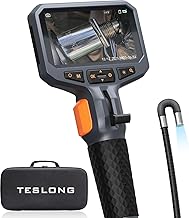 | Teslong Articulating Borescope Mechanic Automotive HVAC | Precise Steering in Cramped Spaces | 8.9/10 | Check price → |
 | Teslong 5” Dual Lens Borescope Camera | Reaching Deep Into Wall Cavities | 8.4/10 | Check price → |
 | Teslong Dual Lens 4-Way Articulating Borescope | Viewing Sides Without Cable Twist | 8.6/10 | Check price → |
 | FOXWELL 2-Way 220° Articulating Borescope Camera | Detecting Tiny Cracks and Debris | 8.7/10 | Check price → |
 | Teslong Articulating Borescope Dual Lens Endoscope | Illuminating Dark Internal Components | 8.2/10 | Check price → |
Scroll sideways on small screens to see every column.
Teslong Articulating Borescope Mechanic Automotive HVAC: Best Overall for Precise Steering
Teslong 5” Dual Lens Borescope Camera: Best for Reaching Deep Cavities
Teslong Dual Lens 4-Way Articulating Borescope: Best for Viewing All Sides
FOXWELL 2-Way 220° Articulating Borescope Camera: Best for Image Clarity
Teslong Articulating Borescope Dual Lens Endoscope: Best for Bright Illumination
Buying Guide: Probe Size, Cable Stiffness, and Resolution
Choosing the right borescope depends entirely on what you’re looking at and how hard it is to reach. Here’s what matters most.
How Does Probe Diameter Affect Access?
Smaller probes fit into tighter spaces but often sacrifice image quality and durability. Most consumer-grade scopes hover around 5.5mm, which fits standard spark plug wells and many HVAC vents. If you’re inspecting fuel injectors or delicate electronic assemblies, you might need sub-4mm tips, though these are rare in this list.
Larger 8mm+ probes offer better optics but won’t enter small engine ports. Match the diameter to your smallest access hole first, then worry about features.
Why Is Cable Stiffness Critical for Steering?
Cable rigidity determines whether you can turn corners inside a housing. Fully flexible cables, like those in the Teslong 5'' Dual Lens Borescope Camera, slide easily through straight tubes but collapse when pushed against bends. Semi-rigid cables hold their curve, letting you steer around obstacles using the articulation wheel.
For complex machinery with multiple turns, stiffness is arguably more important than resolution because a blurry image is useless if you can’t aim the camera correctly.
Does Higher Resolution Always Mean Better Inspections?
Not necessarily. While 1080P sensors capture finer details, they demand more light and processing power. In dark, oily environments, a lower-resolution camera with superior LED arrays might produce clearer, more usable images than a high-res model struggling with glare.
Consider your lighting conditions. If you work in well-lit areas, prioritize megapixels. If you dive into dark engine bays, focus on illumination uniformity and color accuracy instead.
To see how these factors play out on real picks, compare the Teslong Articulating Borescope Mechanic Automotive HVAC, Teslong 5'' Dual Lens Borescope Camera and the Teslong Dual Lens 4-Way Articulating Borescope reviewed above.
Who Should NOT Buy Best Inspection Borescopes for Tight Equipment Housings
These tools are specialized instruments, not universal fixes. Two groups should look elsewhere.
You Need to Measure Distances Precisely
Borescopes lack calibrated depth markers or laser measurement systems. They show you what’s there, but estimating how far away something is remains guesswork based on perspective distortion. If you need exact dimensions for machining repairs, invest in a coordinate measuring machine (CMM) service or hire a metrology specialist.
These cameras visualize problems; they don’t quantify them accurately enough for engineering tolerances.
You Require Industrial Certification Compliance
Consumer borescopes rarely meet aerospace or nuclear industry certification standards like NAS 410 or ASTM E1417. Using uncertified equipment for regulated safety inspectionscan result in rejected audits, legal liability, and potential safety violations. If your inspection falls under these regulatory frameworks, you must use equipment that is traceable to national standards and operated by personnel with specific Level II or III certifications.
In these cases, the cost of compliance outweighs the convenience of a consumer tool.
The Verdict: When to Buy vs. When to Rent/Buy Professional
To make the final decision, ask yourself three questions:
- What is the consequence of error? If missing a crack leads to minor maintenance delays, a $300 borescope is fine. If it leads to catastrophic failure or regulatory fines, invest in professional-grade tools or outsource.
- How often will you use it? For one-off home repairs, rent or buy cheap. For weekly industrial inspections, durability and image clarity justify the higher upfront cost of prosumer models ($800, $1,500).
- Do you need documentation? Consumer apps often save low-resolution screenshots. Professional units generate PDF reports with timestamped, high-fidelity images that are admissible in court or audit trails.
Recommendation Summary:
- Homeowners/Hobbyists: Stick with reputable mid-range brands (like DEWALT, VEVOR’s upper tier, or Arriant) for plumbing checks, wall cavity inspections, and basic automotive diagnostics. Expect to pay $150, $400. Accept that lighting will be poor in deep cavities and images may lack sharpness.
- Small Business/Trade Professionals (HVAC, Auto Repair): Invest in a dedicated unit with articulating steering and at least 720p resolution on a 4.3-inch screen. Brands like GoPro (with accessories), specialized HVAC scopes (e.g., Testo), or entry-level industrial scopes (e.g., Olympus Starter kits) offer better reliability. Budget $500, $1,200.
- Industrial/Aerospace/Nuclear: Do not rely on off-the-shelf consumer electronics. Partner with certified NDT providers or purchase calibrated systems from established manufacturers like Olympus (Evident), GE Sensing & Inspection Technologies, or Waygate Technologies. These systems start at several thousand dollars but include software integration, calibration certificates, and support networks essential for regulated industries.
By matching the tool to the risk profile of your task, you avoid both unnecessary expense and dangerous false negatives. Remember, a borescope is only as good as the eyes, and expertise, behind the screen.

Similar Posts